Limit orders
A market order chooses speed over price. A limit order does the opposite: it chooses price over speed.
What a limit order does
The CFTC defines a limit order as one where the customer sets a maximum purchase price or a minimum sale price. CME says the same thing in its course: a buy limit sets the most you will pay, a sell limit sets the least you will accept.
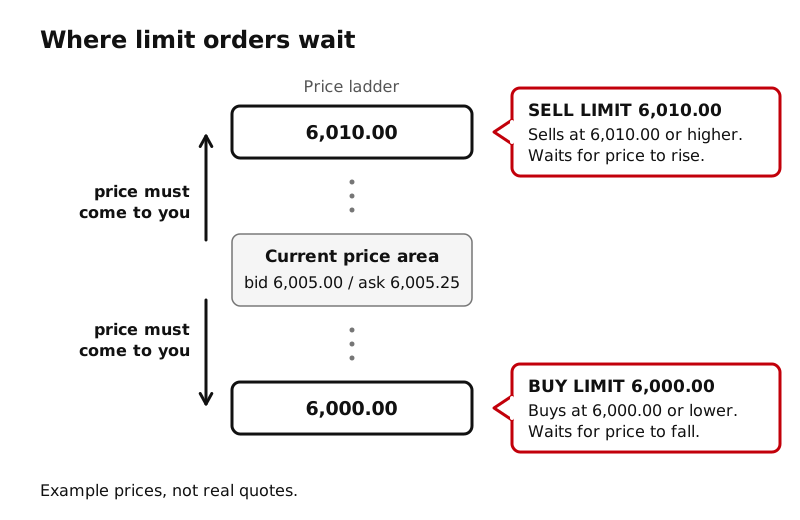
- Buy limit at 6,000.00 means: “Buy, but pay 6,000.00 or less.”
- Sell limit at 6,010.00 means: “Sell, but get 6,010.00 or more.”
(Example prices, not real quotes.)
Never worse, sometimes better
CME puts the rule plainly: a limit order cannot be filled worse than its limit price, but it can be filled better.
CME’s own example, in round numbers: the market is offered at 12 and a trader enters a buy limit at 15. The trader is filled at 12 while sellers remain at 12. The buy could fill at 12, 13, 14, or 15, but never at 16. The limit is a ceiling for a buyer and a floor for a seller, not an exact price.
Resting orders
Most of the time you place a buy limit below the current price, or a sell limit above it, and wait for the market to come to you. CME describes this as an order placed away from where price is trading, in anticipation of price moving toward it.
An order like this does not fill right away. It rests on the exchange’s order book, waiting. CME’s Globex reference says a limit order stays on the book until it is filled, canceled, or expires. You will see your resting orders on your platform, often on the price ladder (Lesson 5).
The trade-off: no fill guarantee
Price control comes with a cost. CME warns that in a fast-moving market a limit order may not be filled, because price keeps moving away from it.
Example prices, not real quotes. You place a buy limit on MNQ at 20,000.00. Price drops to 20,000.25, one tick above your order, then rallies 40 points. Your order never filled. You protected yourself from paying more, and you also missed the move. That is not a mistake. That is exactly what a limit order promises.
Even if price touches your limit, you may not be filled. Other traders may have placed orders at that same price before you, and they are first in line. Lesson 5 explains the queue.
A limit priced through the market
What if you place a buy limit above the current ask? Then your limit is already better than what sellers are asking, so it can fill right away, at the ask or better, just like CME’s 12 and 15 example. It works like a market order with a built-in maximum price.
There is a guard rail here too. CME explains that a limit order priced too far away from the current price is rejected by the exchange’s price banding control. That is meant to stop orders at unrealistic prices.
Key ideas
- A limit order sets the worst price you accept: the most you pay or the least you take.
- It can fill at your limit or better, never worse.
- It may not fill at all if price does not reach it or moves away too fast.
- Limit orders placed away from the market rest on the order book until filled, canceled, or expired.