Market orders
An order is an instruction you send through your broker to the exchange: buy or sell, which contract, how many, and under what conditions. CME calls those conditions order types. The three you will use most are market, limit, and stop orders. This lesson covers the simplest one.
What a market order does
The CFTC defines a market order as an order to buy or sell a futures contract at whatever price is obtainable when it reaches the order book. In plain words: “Fill me now. I will take the best price available.”
You learned in Lesson 1 where that best price is:
- A market buy takes the lowest ask.
- A market sell hits the highest bid.
The trade-off: speed, not price
A market order gives you one thing and costs you another.
What you get: speed. In a busy market there are almost always orders waiting on the other side, so a market order normally fills within moments.
What you give up: control of the price. CME explains that in a liquid market with narrow spreads, like the E-mini S&P 500, a trader generally gets filled quickly near the price shown on the platform. But in a market with a wide spread and low volume, a buyer may be filled at a higher price and a seller at a lower price than expected.
There is no promise that the price you saw when you clicked is the price you get. Prices can move between the moment you look and the moment your order arrives.
A worked example
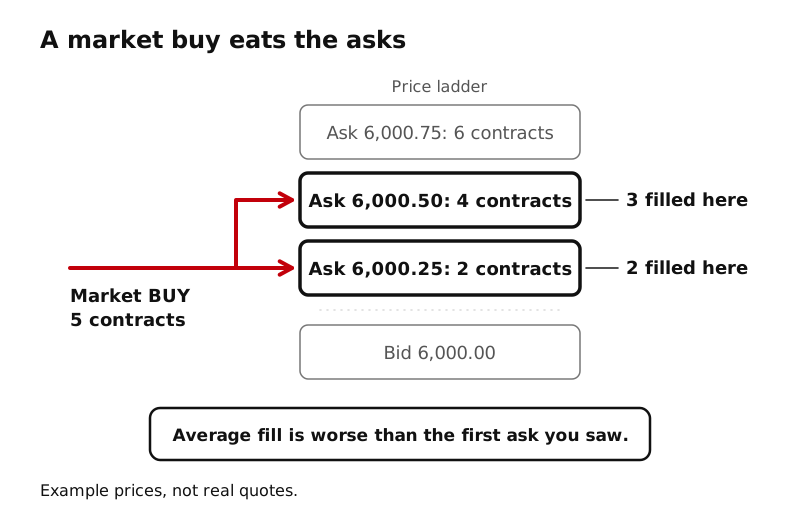
Example prices, not real quotes. You want to buy 1 MES. The screen shows:
- Bid 6,000.00, Ask 6,000.25, and only 2 contracts offered at 6,000.25.
- Next ask level up: 6,000.50.
You send a market buy for 1 contract. There is enough at 6,000.25, so you are filled at 6,000.25.
Now imagine you sent a market buy for 5 contracts. The 2 at 6,000.25 fill first, then the order keeps buying at the next ask level up. Some of your contracts fill at 6,000.50 or higher. Your average price ends up worse than the ask you first saw. On MES each extra tick costs $1.25 per contract (Runner Lesson 6).
How CME Globex handles market orders
Here is a detail most beginner guides skip. CME’s own list of CME Globex order types does not include a plain, unlimited market order. Instead it includes two market-style orders:
- Market order with protection. This is filled only within a pre-set band of prices that CME calls the protected range. For a buy, CME adds a number of protection points to the current best offer to set the highest price the order can pay. For a sell, it subtracts points from the best bid. If part of the order cannot fill inside that band, the rest stays on the book as a limit order at the edge of the range.
- Market-limit order. This fills at the best price available. If it can only partly fill, the rest becomes a limit order and waits on the book instead of chasing price further.
Why it matters: when you click “Buy Market” on a platform, what actually reaches the exchange depends on your broker and platform. Platforms label things differently. The protection exists to stop fills at extreme prices, but it does not guarantee you the price you saw.
When traders use market orders
Market orders are useful when getting in or out now matters more than the exact price, for example when you need to exit a position quickly. They are risky to use in a thin market, or in a moment when prices are jumping, because that is when fills can land far from the screen price. We cover this more in Lesson 6, Fills and slippage.
Key ideas
- A market order says “fill me now at the best available price.”
- A market buy fills at the ask. A market sell fills at the bid.
- You get speed, not price. The fill can be worse than the price you saw, especially in fast or thin markets or with larger size.
- On CME Globex, market orders come as market with protection or market-limit, which limit how far a fill can go. Your platform’s labels may differ.