How prop evaluations work
As you learn about futures, you will hear about prop evaluations (also called challenges or combines). You pay a fee, trade an evaluation account under a set of rules, and if you pass, you may get to trade an account funded by the company. This lesson explains the moving parts so you can read any firm’s rules with clear eyes.
Two things first, stated plainly:
- This is a private company’s product. The rules are written by the firm. They are not exchange rules and not regulator rules.
- Rules vary by firm and can change. Whatever you read here, or anywhere else, check the firm’s own current rules page before you pay for anything. LearnToTick does not recommend or endorse any firm.
The usual parts
Most evaluations combine some version of these pieces. Names differ by firm.
Profit target
A dollar amount you must make to pass. Example (made-up numbers): on a $25,000 practice account, a profit target of $1,500.
Maximum loss (often a trailing drawdown)
A loss limit that ends the evaluation if you hit it. Many firms make it trail: the limit moves up as your balance makes new highs, but never moves back down.
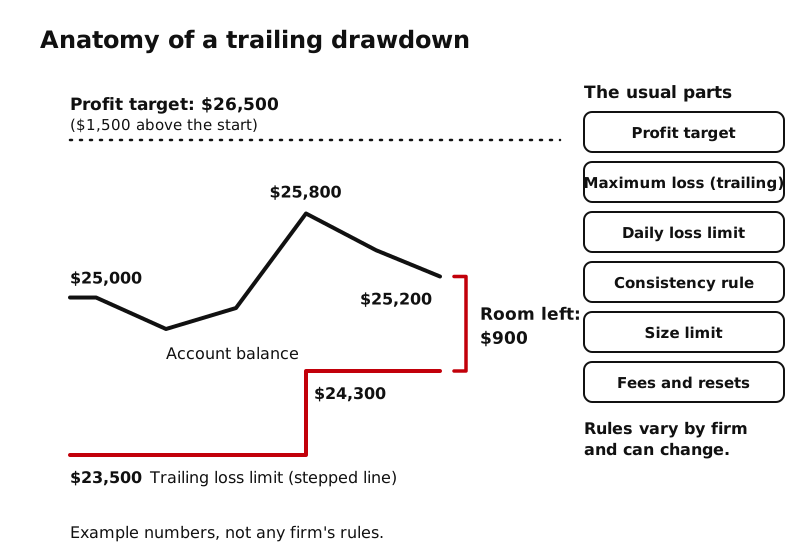
Example with made-up numbers: practice account starts at $25,000, with a $1,500 trailing maximum loss.
| Event | Highest balance so far | Loss limit level |
|---|---|---|
| Start | $25,000 | $25,000 minus $1,500 = $23,500 |
| Balance climbs to $25,800 | $25,800 | $25,800 minus $1,500 = $24,300 |
| Balance falls back to $25,200 | still $25,800 | still $24,300 (it never moves down) |
Notice what happened: after a good run and a pullback, the account is $200 above where it started ($25,200), but the room to lose is now only $25,200 minus $24,300 = $900, not $1,500. A trailing limit punishes giving back profits. Firms define exactly what the limit trails (for example, the end-of-day balance or the balance during the day) in different ways, so read your firm’s definition carefully.
Daily loss limit
Some firms add a maximum loss for a single day, like the personal daily limit in Lesson 7, but enforced by the firm.
Consistency rules
Some firms limit how much of your total profit can come from one day, so a single lucky day cannot carry the whole evaluation.
Size limits
A maximum number of contracts you may hold at once.
Fees and resets
You pay to take the evaluation, sometimes as a recurring subscription (Topstep, for example, describes a monthly rebill). If you break a rule, you may be able to pay for a reset that starts the evaluation over. Passing may involve another fee to activate a funded account.
One real example, with a date
To show what real rules look like, here is a summary in our own words of a few items from Topstep’s help center, read on 2026-10-06. These can change at any time; the links are the source of truth.
- Maximum Loss Limit for the Trading Combine: $2,000 on the 50K account, $3,000 on 100K, $4,500 on 150K. Topstep describes it as trailing: it rises as the end-of-day balance grows and never moves down, but it is monitored during the day, and hitting it closes the account. It stops trailing once it reaches the starting balance. (https://help.topstep.com/en/articles/8284204-what-is-the-maximum-loss-limit)
- Size limits: 50K allows 5 contracts or 50 micros; 100K allows 10 or 100; 150K allows 15 or 150. (https://help.topstep.com/en/articles/8284197-trading-combine-parameters)
- Consistency: the same article says your best single day should stay below 55 percent of the profit target. (same link)
- Reset: returns the Combine to its starting state; Topstep says each monthly rebill includes one reset credit, and more can be bought. (https://help.topstep.com/en/articles/8284128-what-is-the-reset)
This example is not a recommendation of Topstep or any firm. Disclosure: George, who runs LearnToTick, is a TopstepTV contributor.
How this connects to your risk math
Everything in this level applies, with one twist: the firm’s maximum loss is your real account size. A “$25,000” evaluation with a $1,500 maximum loss behaves like a $1,500 account for risk purposes. Run Lesson 2’s question on that number: how many full losses at your risk per trade fit inside it?
Example (made-up): $1,500 room, $100 risk per trade. That is 1,500 divided by 100 = 15 full losses to zero room, and fewer once the limit trails up.
Key ideas
- An evaluation is a private firm’s product, not an exchange or regulator rule. Rules vary by firm and change.
- Common parts: profit target, maximum loss (often trailing), daily loss limit, consistency rules, size limits, fees and resets.
- A trailing limit moves up with new highs and never down, so giving back profit shrinks your room.
- Treat the maximum loss as your true account size when you do your risk math.
- Always read the firm’s current rules page yourself before paying.