Overnight and news risk
Everything you have learned in this level assumes your stop fills close to its price. Most of the time, during active trading, that is a reasonable assumption. This lesson is about the moments when it is not: when the market is closed, and when big news hits.
When you cannot trade, price can still change
You learned the clock in Runner Lesson 10. ES, NQ, MES, and MNQ trade on CME Globex from Sunday 5:00 p.m. CT to Friday 4:00 p.m. CT, with a daily break from 4:00 p.m. to 5:00 p.m. CT.
That leaves windows where no one can trade the contract: the daily break, and the whole weekend from Friday 4:00 p.m. CT to Sunday 5:00 p.m. CT. The world does not stop during those windows. News, events, and other markets keep moving. When trading resumes, price can open at a very different level from where it stopped. On a chart that shows up as a gap, which you studied in Clerk Lesson 10.
Why a gap can jump your stop
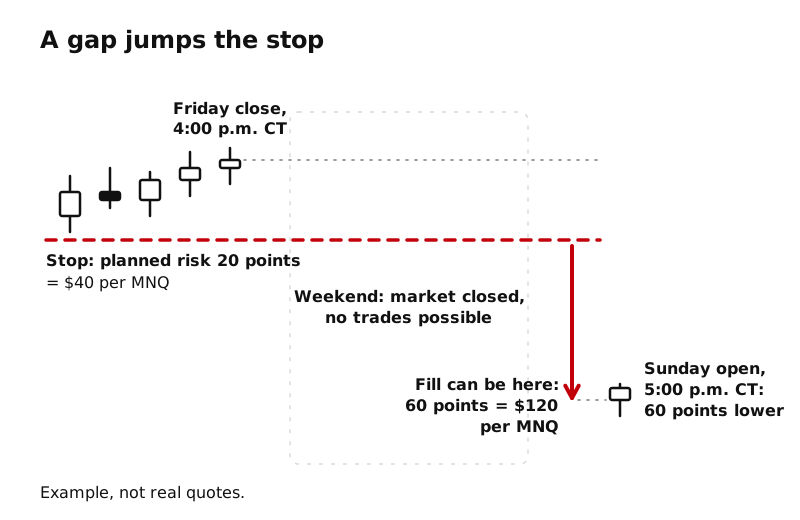
Say you hold 1 MNQ long over the weekend with a stop 20 points below the Friday close. Your planned risk is 20 times $2 = $40 (Lesson 4).
Now suppose (made-up numbers) the market reopens on Sunday 60 points lower than Friday’s close. There was never a chance to sell at your stop price, because no trading happened between the close and the open. Your stop triggers at the open and becomes a market order.
- Planned loss: 20 points times $2 = $40
- Possible loss if filled near the open: 60 points times $2 = $120, three times the plan, and it could be worse
FINRA explains the general mechanism: a stop turns into a market order once its price is reached, and the fill can be markedly different from the stop price when markets move fast. The CFTC’s risk disclosure adds that in some conditions it can be difficult or impossible to exit a position at all.
News during the session
Gaps are not only a weekend thing. Scheduled economic releases (Floor Trader Lesson 13 covers the calendar) can move prices quickly, even while the market is open. In those moments, orders can fill well away from their prices, as FINRA describes for fast markets (Order Filler covers fills and slippage).
Holding a position through a known release is a decision about risk, not just about direction. You are accepting that your planned loss may not be your real loss.
Margin can change
Runner Lesson 8 explained that day-trading margin is a lower rate a broker offers for positions opened and closed within the session, and that holding into the next trading day can require the higher full margin. It also explained that the clearing house can raise margin when markets get more volatile.
So a position that fit your account during the day may need much more money overnight. The CFTC’s risk disclosure warns that your broker can demand a substantial amount of additional margin on short notice, and if you do not provide it, your position can be closed at a loss with you owing any shortfall. Check your broker’s overnight margin before you ever hold a position past the session.
Flat is a position
Here is the process idea that ties this lesson together: being flat (no position) is a position. It is a choice you make on purpose, not a failure to act.
There are moments when the risk on a trade is unusually hard to measure: just before a major scheduled release, into the daily break, or into the weekend. In those moments your stop, your position size, and your daily loss limit all become less reliable, because the real loss can jump past them. Choosing to be flat means choosing a risk you can measure: zero.
Practical habits many traders write into their risk plan (Lesson 14):
- Know the release times for the day before you trade (all in CT).
- Decide in advance whether you will be flat into big news, and write it down.
- Decide whether you ever hold overnight or over the weekend, and if so, at what size.
- If you do hold, size for the gap, not just the stop.
None of this tells you what to trade. It tells you when your normal risk math stops being trustworthy.
Key ideas
- The market closes daily from 4:00 to 5:00 p.m. CT and from Friday 4:00 p.m. to Sunday 5:00 p.m. CT; price can reopen far away, creating a gap.
- A stop does not protect you from a gap: it becomes a market order and can fill much worse.
- Fast news moves can do the same thing during the session.
- Holding overnight can need more margin, and brokers can demand extra margin on short notice.
- Flat is a position: when risk is hard to measure, no position is a valid choice.