Key reference levels
In Lesson 3 you learned that previous highs and lows can act as support and resistance. Some highs and lows come up every single day, so it helps to give them names and mark them on the chart before the session starts. This lesson covers the ones this course uses.
None of these levels is a signal. They are landmarks: prices where something happened recently that are worth knowing about.
A quick reminder about the clock
From Runner Lesson 10: ES, NQ, MES, and MNQ trade on CME Globex from Sunday 5:00 p.m. CT to Friday 4:00 p.m. CT, with a daily break from 4:00 p.m. to 5:00 p.m. CT. RTH is 8:30 a.m. to 3:00 p.m. CT, which matches the NYSE core session (9:30 a.m. to 4:00 p.m. ET). Everything outside RTH is the overnight session.
Because of this, “yesterday’s high” can mean two different things: the high of yesterday’s RTH session only, or the high of the full Globex day. Either is fine as long as you know which one you are using. Some charting platforms let you choose. TradingView, for example, can show CME futures with the full electronic session or with RTH only, and its help page notes that RTH only lets you find new highs and lows without the bars outside RTH. (Its RTH setting runs to 3:15 p.m. CT, a little past this course’s 3:00 p.m. CT.)
Prior day high and low
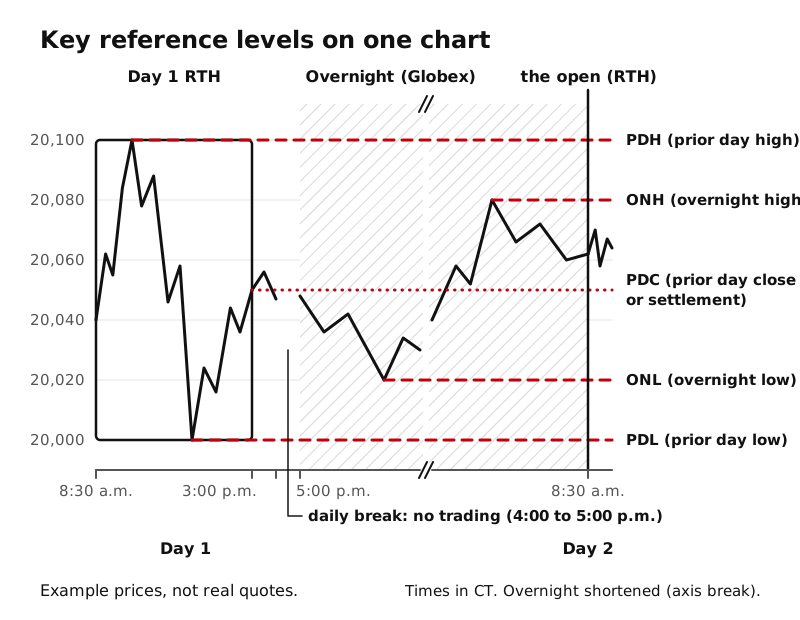
The prior day high (this course writes it PDH) is the highest price of the previous session. The prior day low (PDL) is the lowest. They mark the edges of where the market traded yesterday.
These are just the most recent “previous highs and lows” from Lesson 3, the kind of price CME’s course says markets often pause near.
Prior day close
The prior day close (PDC) needs a little care with futures. There are two candidates:
- The last RTH price, the last trade near 3:00 p.m. CT.
- The daily settlement price. From Runner Lesson 12, the exchange sets one official settlement price per contract each day. CME Group explains that for most equity index futures, this price is calculated as a volume-weighted average of trades in the final 30 seconds of the trading day.
These are often close to each other but not always identical, and platforms differ in which one they show. On TradingView, for example, daily bars for futures use the settlement price as the close by default (you can switch to the last trade of the trading day instead, which is not the same as the last RTH trade), and its watchlist always uses settlement. Check your platform’s settings so you know which one you are looking at.
Whichever you use, the prior close is worth knowing. TradingView’s help page on the previous close points out that traders compare the open with it to spot gaps, and watch how price behaves around it as possible support or resistance.
Overnight high and low
The overnight high (ONH) and overnight low (ONL) are the highest and lowest prices traded on Globex between the 5:00 p.m. CT reopen and the 8:30 a.m. CT RTH open. They show how far the market traveled while the stock market was closed.
The open
The open is the first price of the RTH session at 8:30 a.m. CT. Futures have been trading all night, so the open is not the start of trading. It marks the moment the U.S. stock market’s core session begins and the cash stocks start trading alongside the futures.
The open is also where the next lesson, the opening range, begins.
Using the levels as a map
Before the RTH open, write down these numbers: PDH, PDL, PDC, ONH, ONL. When the market opens, add the open. Now you have a map of the most recent landmarks above and below the current price.
What the map tells you is context. For example, if price opens above the prior day high, the market is trading somewhere it did not trade at all yesterday. If it opens between the prior day high and low, it is back inside yesterday’s territory. Those are descriptions, not instructions. Lesson 14 turns this into a short routine.
Key ideas
- PDH and PDL: the high and low of the previous session (RTH or the full Globex day; know which).
- PDC: the last RTH price or the official settlement price; know which your platform shows.
- ONH and ONL: the high and low of the overnight Globex session before the 8:30 a.m. CT open.
- The open: the first RTH price at 8:30 a.m. CT.
- These levels are landmarks for context, not signals.