Your daily routine
Think of an athlete on game day: warm up, play to a plan, review afterward. A trading day can work the same way. A routine turns all the separate lessons of Seat Holder (rules, journal, limits, review) into one repeatable day. It has three parts: before, during, and after.
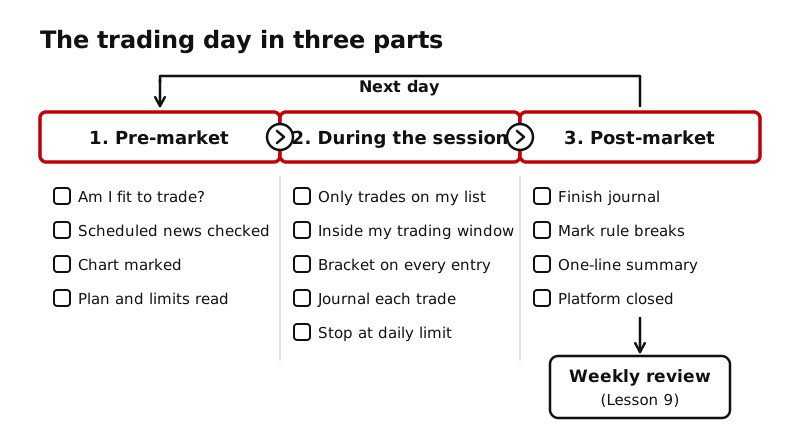
1. Pre-market: get ready
This happens before the part of the session you trade. Many students trade during regular trading hours, which you learned about in Runner Lesson 10, but your routine works the same whatever window you choose.
Check yourself first
Before you look at a chart, look at yourself. Tired, sick, angry, rushed, or distracted? NFA’s guidance for people starting out in futures lists your temperament, your tolerance for risk, and how much time and attention you can give among the things to weigh when deciding how to take part. Bring the same honesty to each morning. Some days the honest answer is “not today.” A day you choose not to trade is a day you cannot lose money.
A simple version: rate yourself 1 to 5 on sleep, stress, and focus. Set a rule in advance for what score means you sit out or trade smaller.
Check the calendar
In Floor Trader Lesson 13 you learned that scheduled economic news can cause fast moves and wider spreads. Check what is scheduled today and when (in CT), and decide in advance what your plan says to do around those times.
Mark your chart
Floor Trader Lesson 14 walked through a pre-market routine for marking your reference levels. Do it now, before the session, so you are not drawing lines in a rush while price is moving.
Read your plan
Read your one-page trading plan (Lesson 12). It takes a minute. Remind yourself of your trading window, what is on your list, your risk per trade, and your daily loss limit and maximum trades. Read it even when you think you know it.
2. During the session: follow the plan
This part should be the most boring. All the thinking was done in advance.
- Only trades on your written list. If you cannot name the rule, do not take it (Lesson 4).
- Inside your trading window only.
- Bracket on every entry (Order Filler Lesson 7).
- Journal as you go. At minimum, write the reason before entry and the rule-following check after exit (Lesson 8).
- Watch your warning signs for tilt (Lesson 3).
- Stop when a limit is hit: daily loss limit, maximum trades, or your own end time. FINRA’s investor guidance warns that jumping in and out on impulse can hurt results; a fixed stopping point removes that chance.
3. Post-market: close the day
- Finish the journal while the trades are fresh: screenshots, emotions, rule-following.
- Mark any rule breaks clearly. Do not fix your whole method tonight; save that for the weekly review (Lesson 9).
- Write a one-line summary: what went well, what did not.
- Close the platform. End the trading day on purpose. This matters most on a frustrating day, when “one more trade” is tempting.
Then step away. A fixed end to the day helps keep trading from bleeding into the rest of your life.
Keep it short and repeatable
A routine that takes an hour will be skipped. Start with the version you can do every single day, even if it is only ten minutes before and ten after. Write it down as a checklist and keep it next to your screen. Once it is a habit, you can add to it.
Key ideas
- A daily routine has three parts: pre-market, during the session, and post-market.
- Pre-market: check yourself first, then scheduled news, your marked chart, and your plan.
- During: trade only your list, inside your window, with brackets, and stop at your limits.
- Post-market: finish the journal, mark rule breaks, summarize, and close the platform.
- Keep the routine short enough that you do it every day.