Journaling
Lessons 1 to 7 kept pointing here: “your journal will show it.” This lesson is about building that journal. A trading journal is one of the most useful tools in this course, and it costs nothing but a few minutes per trade.
Why your memory is not enough
At the end of a session, try to recall every trade: the exact entry, why you took it, how you felt. It is hard. And the parts you do remember are easy to edit without noticing.
Lesson 7 introduced self-attribution bias, described in a research summary prepared by the Library of Congress for the SEC: crediting yourself for successes and blaming luck or others for failures. Without a written record, nothing stops that bias from editing the story. A week later, the winners were “great reads” and the losers were “bad luck.” The Nobel committee’s background on Kahneman’s work also describes how people draw strong conclusions from short sequences of results. A journal gives you the full sequence, written down, so you can judge it properly.
What to record
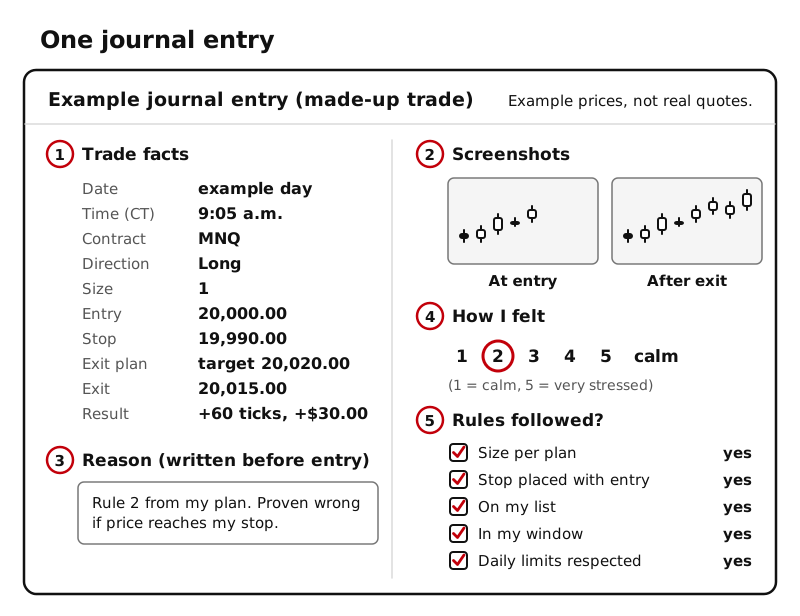
A good journal entry has five parts. Keep it short enough that you will actually fill it in every time.
1. The trade facts
- Date and time (in CT)
- Market and contract (for example MNQ)
- Long or short, and size (number of contracts)
- Entry price, stop price, target or exit plan
- Exit price
- Result in ticks or points, and in dollars (Runner Lesson 6 has the math)
2. Screenshots
Take a chart screenshot at entry and another after exit. The entry picture shows what you saw when you decided. The exit picture shows what happened. Weeks later, these are worth more than any written description.
3. The reason, written before entry
One or two sentences: which rule from your plan this trade comes from, and what would prove it wrong. Write it before you click. This is the part that protects you from rewriting history. If you cannot write a reason, that is your answer: do not take the trade (Lesson 4).
4. How you felt
A quick note on your state before and during the trade. Some traders use a 1 to 5 scale (1 = calm, 5 = very stressed) plus one word, like “bored,” “rushed,” “angry,” or “confident.” Over time this shows you which feelings come before your worst trades (Lesson 3).
5. Did you follow your rules?
A simple yes or no for each rule that applied: size, stop placed with entry, trade on your list, within your trading window, daily limits respected. If anything was broken, note which rule and why.
This field matters most. Profit depends partly on chance; rule-following is fully under your control.
Journal every trade, including sim
Record every trade, not just the interesting ones. The boring trades are the baseline; the losing ones are where the lessons hide. And start now, on the simulator (Local Lesson 15). Sim trades are a perfect place to build the habit before real money adds pressure.
Where to keep it
A spreadsheet, a notebook, or a dedicated journaling app all work. Pick the format you will actually keep up. A spreadsheet has one advantage: it makes the measurements in Lesson 10 easy to calculate.
Key ideas
- Memory is incomplete and biased. A journal shows what really happened.
- Five parts: trade facts, screenshots (entry and exit), the reason written before entry, how you felt, and whether you followed your rules.
- Writing the reason first protects you from self-attribution bias and hindsight.
- Rule-following is the most important field, because it is fully under your control.
- Journal every trade, starting in sim.