Long and short
Most people only know one way to make money in markets: buy something, hope it goes up, sell it later. In futures, there is a second way that is just as easy. You can sell first and buy back later. This lesson explains both directions.
Going long
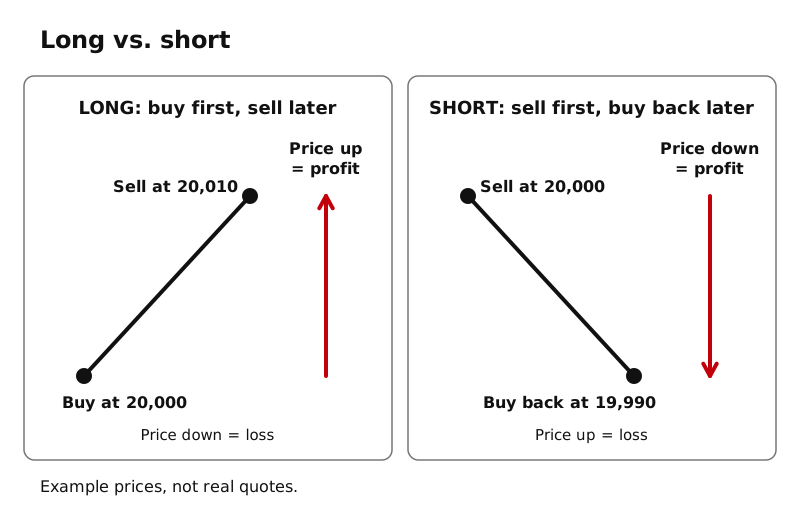
Long means you bought. You make money if the price goes up.
- You buy 1 MNQ at an example price of 20,000.00.
- The price rises to 20,010.00, and you sell.
- That is 10 points times $2 = $20 profit.
If the price had fallen 10 points instead, you would have lost $20. Long means you want the price to rise.
Going short
Short means you sold first. You make money if the price goes down.
- You sell 1 MNQ at an example price of 20,000.00.
- The price falls to 19,990.00, and you buy it back.
- That is 10 points times $2 = $20 profit.
If the price had risen 10 points instead, you would have lost $20. Short means you want the price to fall.
(Prices in these examples are made-up round numbers, not real quotes.)
Wait, how can you sell something you do not have?
Remember Lesson 1: a futures contract is an agreement about a future trade, not a thing you own. Selling a contract just means you have taken the seller’s side of that agreement. You do not need to own anything first.
That is very different from the stock market, where shorting a stock depends on shares being available, and where there can be extra rules about when you are allowed to short. CME points out that futures do not have those same restrictions: you can take a short position as easily as a long one. On your trading platform, it is literally a different button: Sell instead of Buy.
Opening and closing
Every trade has two halves:
| To open | To close | |
|---|---|---|
| Long | Buy | Sell |
| Short | Sell | Buy |
Closing a position means making the opposite trade in the same contract and the same quantity. If you are long 2 MNQ, you sell 2 MNQ of that same contract month to get out. If you are short 1 MES, you buy 1 MES to get out. Once your opposite trade is done, you are flat, which means you have no position.
The math is the same in both directions
Profit and loss work exactly the same way for longs and shorts: ticks moved, times dollars per tick, times contracts. The only difference is which direction counts as a win.
That symmetry includes the risk. A long position loses money when the price falls, and a short position loses money when the price rises. Neither direction is safer. A price can keep rising for a long way, so a short trade that goes wrong can lose just as fast as a long trade that goes wrong.
Key ideas
- Long = you bought first. You profit if the price goes up.
- Short = you sold first. You profit if the price goes down.
- In futures, selling short is as simple as clicking Sell. No borrowing needed.
- To close, make the opposite trade in the same contract and quantity. Then you are flat.
- Gains and losses are calculated the same way in both directions.