Brokers and platforms
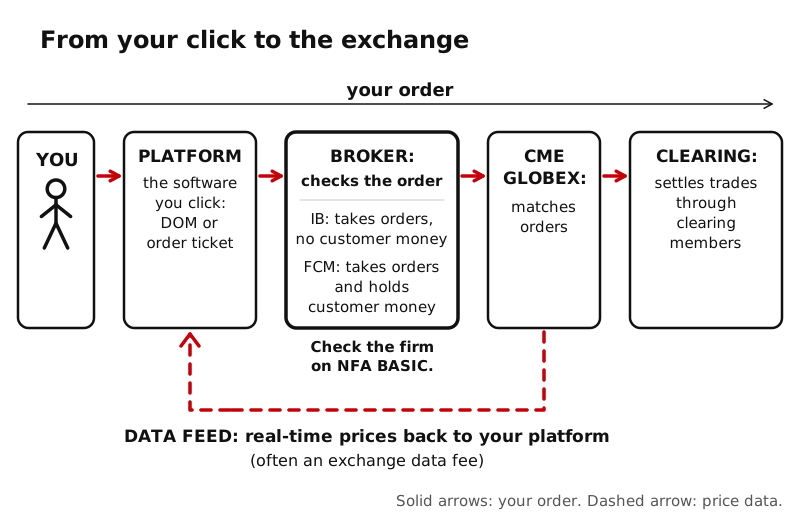
You cannot walk up to CME and place a trade. CME’s course is direct about it: individual traders cannot interact with the exchange themselves, so they rely on a broker. This lesson explains who sits between you and the exchange, and the difference between the software you click and the prices that feed it.
What a futures broker does
CME describes brokers as the link between the trader and the exchange, with three main jobs:
- Provide software for placing orders.
- Manage client deposits, the money in your account.
- Connect you to the exchange, sending your orders there and handling the flow of money between the exchange and your account.
Brokers also check your orders before they leave. CME explains that your broker verifies that an order meets your account’s limits, such as the contract, the number of contracts, and enough margin. Some brokers add extra safety checks, such as a maximum number of contracts per order, two-step order confirmation, or blocking a buy priced above the offer. These vary by broker.
FCM and IB: two kinds of broker
U.S. futures firms that deal with customers register in different categories (you met the NFA in Runner Lesson 13). Two matter here:
- A Futures Commission Merchant (FCM) takes customer orders and accepts customer money to support those orders, according to the NFA.
- An Introducing Broker (IB) also takes customer orders but does not accept customer money to support them, according to the NFA.
So of these two, only the FCM can hold the money you deposit for futures trading.
Behind the FCM is the clearing system. The CFTC glossary explains that every trade by a firm that is not a clearing member must be processed and settled through a clearing member of the clearing organization.
Whichever firm you deal with, look it up on NFA BASIC first, as Runner Lesson 13 showed.
The platform
The platform is the software where you watch prices and send orders. CME says each broker’s software looks a little different, but all of it lets you place futures orders. Two common styles:
- a DOM, the price ladder you drag and click on (Lesson 5), and
- an order entry screen, where you type in the details.
CME notes most brokers offer desktop and mobile versions. Some brokers charge a monthly platform fee for the software, which may be reduced or waived depending on account size and how much you trade.
The data feed
The platform is the screen. The data feed is what fills it: the stream of real-time prices, bids, offers, and volume. CME’s course lists a data feed fee as a separate cost, charged by the exchange to provide real-time and historical price data. Depending on the broker, it may be bundled into other costs or charged separately.
CME also points out that real-time streaming data put individual traders on a more level footing, since they are no longer looking at prices 15 to 20 minutes old. When you set up a platform, confirm your prices are real-time, not delayed. Placing orders off a delayed chart is a recipe for confusion.
What to compare
CME suggests weighing three things when choosing a broker: technology (does the platform do what you need), cost (commissions, platform fees, data fees, covered in the next lesson), and trading permissions (minimum deposit, margin, whether overnight positions are allowed, and which contracts you may trade). These differ from broker to broker. This course does not recommend any broker; it teaches you what to ask.
Key ideas
- Individual traders reach the exchange through a broker, which supplies software, holds deposits, checks orders, and routes them.
- An FCM accepts customer money; an IB takes orders but does not hold customer money.
- The platform is the software. The data feed is the live price stream, often with its own exchange fee.
- Make sure your data is real-time, and check any firm on NFA BASIC.