Fills and slippage
You clicked Buy at what looked like 6,000.25. Your platform says you were filled at 6,000.50. Nobody cheated you. This lesson explains what happened, and why it will keep happening, a little, for as long as you trade.
What a fill is
The CFTC glossary defines a fill simply as the execution of an order. When your platform says “filled,” your order has been matched and you now hold (or have closed) a position.
Partial fills
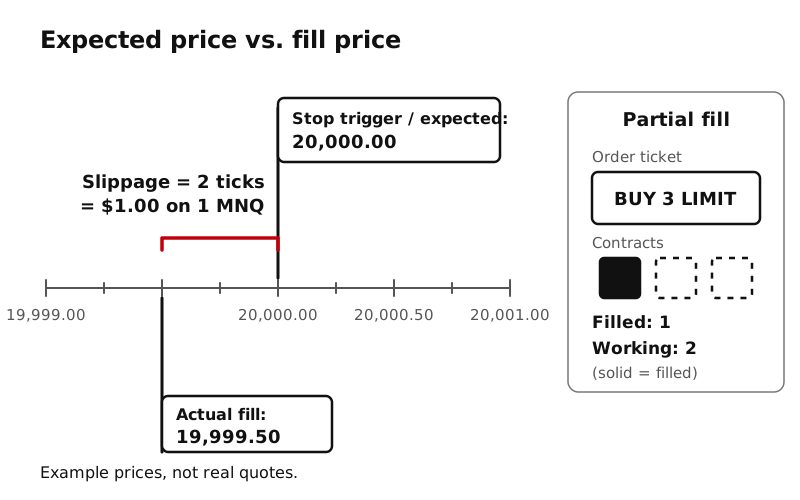
Orders do not always fill all at once. A partial fill means some of your contracts have been executed and the rest have not, yet.
How it happens:
- Limit orders. Say you rest a buy limit for 3 contracts. Only 1 contract is sold to you at your price before the market moves away. You now hold 1 contract and have a working order for 2 more. CME’s Globex reference says a limit order stays on the book until it is filled, canceled, or expires, so the leftover 2 keep waiting.
- Market-style orders on Globex. CME explains that if a market-limit order can only partly fill, the rest becomes a limit order on the book. If a market order with protection reaches the edge of its protected range, the rest also waits there as a limit order.
The practical lesson: after any order, check your position size, not just the word “filled.” You may be holding fewer contracts than you meant to, with an order still working.
What slippage is
Slippage is the trader’s word for the gap between the price you expected and the price you got. Traders usually count it in ticks. Slippage can go against you or, sometimes, in your favor, but traders mostly talk about it when it hurts.
You can turn it into dollars with the same recipe from Runner Lesson 6:
ticks of slippage, times dollars per tick, times contracts
Example (made-up prices, not real quotes): your MNQ stop triggers at 20,000.00 and you are filled at 19,999.50. That is 0.50 points, or 2 ticks. At $0.50 per tick on 1 MNQ, the slippage cost $1.00. On 1 NQ the same 2 ticks would be $10.00.
Why you do not always get your price
Four common causes, all tied to things you have already learned:
- The spread. If you watch the last price but buy with a market order, you pay the ask (Lesson 1).
- Size versus the book. If your order is larger than what waits at the best price, it fills at worse prices too (Lessons 2 and 5).
- Moving prices. CME warns that in a market with a wide spread and low volume, buyers may pay more and sellers receive less than expected. Prices can also move between your click and your fill.
- Stops becoming market orders. The SEC explains that a stop price is only a trigger. Once triggered, a stop market can fill well away from that price if few orders are nearby (Lesson 4).
Guard rails, not guarantees
CME runs controls that limit extreme fills. Market and stop orders with protection can only fill inside a set range. CME also describes velocity logic, which pauses matching when price moves too far, too fast, so orders are not filled at extreme levels. The CFTC glossary describes a related CME feature, stop logic, a momentary pause when triggered stops would push the market outside set limits.
These reduce the worst outcomes. They do not promise you the price you saw.
Living with it
A limit order removes negative slippage on price, but swaps it for the risk of no fill (Lesson 3). A market or stop market order gets you out, but accepts slippage. Neither is “right.” Knowing which risk you are choosing, on every order, is the skill.
Key ideas
- A fill is an executed order. A partial fill leaves part of the order still working; always check your actual position size.
- Slippage is the gap between the expected price and the actual fill, counted in ticks and turned into dollars with tick value times contracts.
- Causes: the spread, size larger than the best price, moving or thin markets, and stops turning into market orders.
- Exchange protections limit extreme fills but do not guarantee your price.