Position sizing
You have a risk per trade (Lesson 2) and a stop price that comes from your idea (Lesson 3). Position sizing joins them: it tells you how many contracts you can trade so that, if the stop is hit, you lose about your planned amount and no more.
This lesson uses only micro contracts and the values you learned in Runner Lesson 6: MNQ is $2 per point ($0.50 per tick) and MES is $5 per point ($1.25 per tick). One point is 4 ticks.
Step 1: dollar risk of one contract
First, work out what the stop costs on one contract.
Dollar risk per contract = stop distance in points times dollars per point.
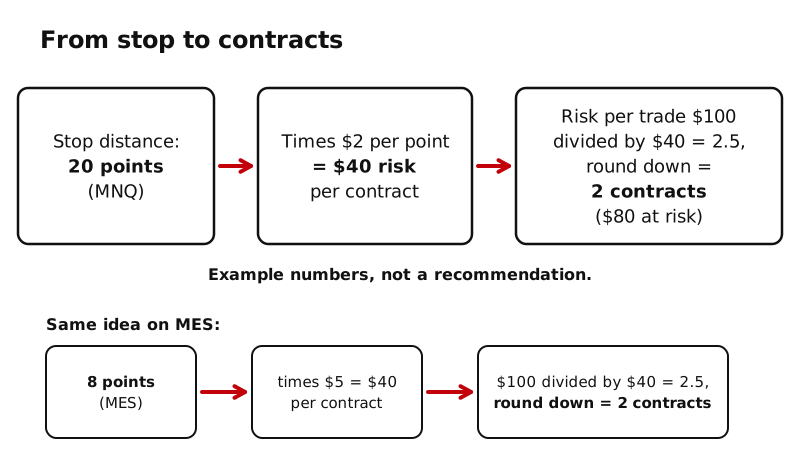
The anchor example for this lesson: a 20-point stop on MNQ.
- Stop distance: 20 points
- MNQ value: $2 per point
- 20 times $2 = $40 per contract
Check it with ticks: 20 points times 4 = 80 ticks, and 80 times $0.50 = $40. Same answer.
Step 2: divide your risk by it
Contracts = risk per trade divided by dollar risk per contract. Round down.
Example (made-up numbers): your risk per trade is $100.
- $100 divided by $40 = 2.5
- Round down: 2 contracts
- Actual risk: 2 times $40 = $80, which is inside your $100 plan.
Why round down? Three contracts would be 3 times $40 = $120, which is more than the $100 you decided to risk. Position sizing exists to stop exactly that.
A second example with MES
Same $100 risk per trade, but now an 8-point stop on MES.
- 8 points times $5 = $40 per contract
- $100 divided by $40 = 2.5, round down = 2 contracts
- Actual risk: $80
Interesting: an 8-point MES stop and a 20-point MNQ stop cost the same per contract. Points alone do not tell you the risk. Points times the dollar value of the contract does.
When the stop is wider
Keep the $100 risk, but suppose your idea needs a 60-point MNQ stop.
- 60 times $2 = $120 per contract
- $100 divided by $120 = about 0.83
- Round down: 0 contracts
Zero means even one contract is too much risk for this stop. The honest choices are to skip the trade or wait for a different one. The wrong choice is to shrink the stop to 50 points just to make one contract fit, because then the stop is no longer where your idea is wrong (Lesson 3).
Size changes, risk does not
Here is the big idea. With position sizing, your dollar risk stays roughly the same on every trade, and the number of contracts is what changes:
| Stop (MNQ) | Risk per contract | Contracts for $100 risk | Total risk |
|---|---|---|---|
| 10 points | 10 times $2 = $20 | 100 divided by 20 = 5 | $100 |
| 20 points | 20 times $2 = $40 | 2.5, round down = 2 | $80 |
| 30 points | 30 times $2 = $60 | about 1.67, round down = 1 | $60 |
| 60 points | 60 times $2 = $120 | about 0.83, round down = 0 | $0 (skip) |
Tight stop: more contracts. Wide stop: fewer contracts. That is the opposite of what many beginners do, which is to trade the same number of contracts every time and let the dollar risk swing wildly.
Leverage reminder
Margin may let you open far more contracts than this math allows. That does not make it safe. The CFTC’s risk disclosure warns that the leverage from small margin requirements can work against you as well as for you. Let your risk per trade decide your size, never the most your account margin will allow.
Key ideas
- Dollar risk per contract = stop points times dollars per point. A 20-point MNQ stop is 20 times $2 = $40 per contract.
- Contracts = risk per trade divided by risk per contract, always rounded down.
- If the answer is less than 1, skip the trade; do not squeeze the stop.
- Position sizing keeps dollar risk steady while the number of contracts changes.
- Size from your risk plan, not from how much margin allows.