Candle anatomy
A candlestick looks simple: a block with a line through it. But every candle on your screen is a small summary of everything that traded in one period. Once you can name its parts, you can read any candle in a second. CME Group’s technical analysis course describes the candle in two main parts, the body and the wick. Let’s build one from the four prices underneath.
The four prices: O, H, L, C
Every candle is drawn from four numbers. Traders shorten them to OHLC:
- Open (O): the first price traded in the period.
- High (H): the highest price traded in the period.
- Low (L): the lowest price traded in the period.
- Close (C): the last price traded in the period.
The high is always at or above the other three. The low is always at or below the other three. The open and close can be anywhere in between.
The body
The body is the thick rectangle. It runs from the open to the close. A long body means price traveled a long way from where the period started to where it ended. A short body means the open and close were close together.
The body tells you nothing about which end is the open and which is the close just by its length. That is the job of the candle’s fill, which you will learn in Lesson 4.
The wicks
The wicks are the thin lines sticking out of the body, one above and one below.
- The upper wick runs from the top of the body up to the high.
- The lower wick runs from the bottom of the body down to the low.
A wick shows where price went during the period but did not stay. If there is no upper wick, the high of the period was at the top of the body. If there is no lower wick, the low was at the bottom of the body.
The range
The range is the full height of the candle, from the tip of the upper wick (the high) to the tip of the lower wick (the low). It tells you how far price traveled from one extreme to the other during the period.
A worked example
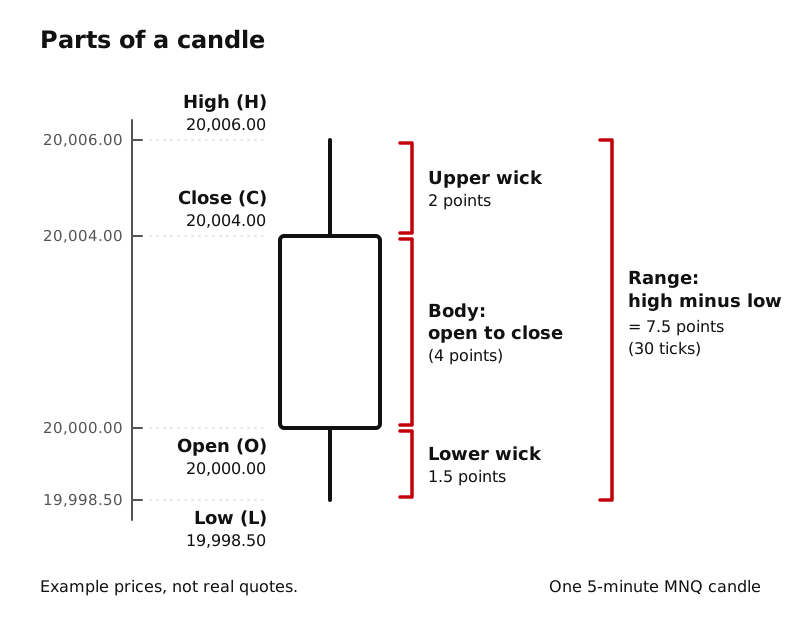
Example prices, not real quotes. A 5-minute MNQ candle has:
- Open 20,000.00
- High 20,006.00
- Low 19,998.50
- Close 20,004.00
Reading it part by part:
- Body: from 20,000.00 to 20,004.00, which is 4 points.
- Upper wick: from 20,004.00 up to 20,006.00, which is 2 points.
- Lower wick: from 20,000.00 down to 19,998.50, which is 1.5 points.
- Range: 20,006.00 minus 19,998.50 = 7.5 points.
Check the parts add up: 2 (upper wick) + 4 (body) + 1.5 (lower wick) = 7.5 points, the full range.
In ticks, using Runner Lesson 6 (4 ticks per point): the range is 7.5 times 4 = 30 ticks. On one MNQ contract at $0.50 per tick, the full range of that candle spans 30 times $0.50 = $15.
Key ideas
- Every candle is built from four prices: open, high, low, close (OHLC).
- The body runs from the open to the close.
- The upper wick reaches the high; the lower wick reaches the low.
- A wick shows where price went but did not stay.
- The range is high minus low, the full length of the candle.